



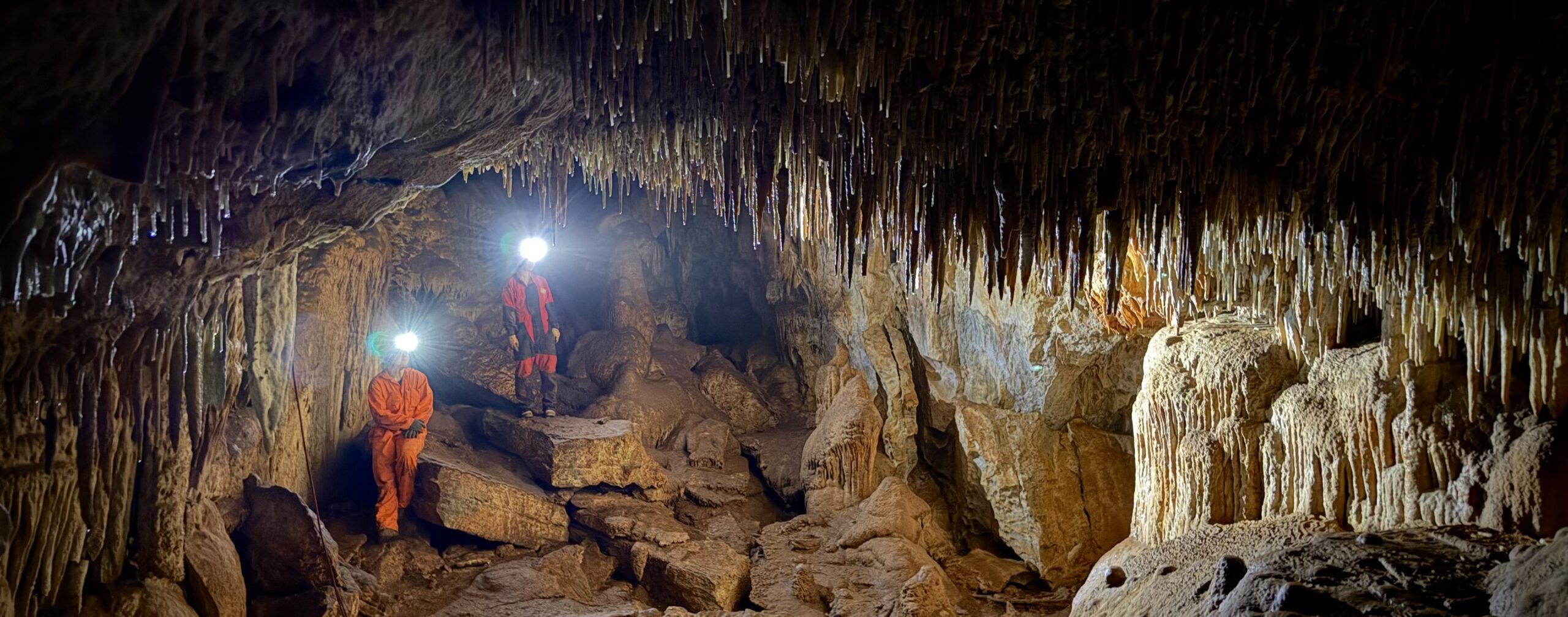
Caving (or spelunking for the Americans) is best described as the exploration and mapping (surveying) of underground systems for a range of purposes, including recreation and research.
Caves offer an invaluable record of the geological and environmental history of a region, telling us about the ice ages and providing a living record of the flora & fauna that lived at these times.
Caving usually involves a lot of crawling, squeezing, abseiling, ladder climbing, SRT (Single Rope Techniques) and general worming around.
Caving is an experience like no other…but make sure you're not claustrophobic.
The fruits of your labour lie in wait, formations of all shapes and sizes glimmering in your torch light. If you're lucky you'll see flowstone taller than houses, rimstone dams so big they're nicknamed "the bathtub", perfectly round oolites gathered in pools and rafts delicately covering pools of calcite-rich water.
Solution caves form by dissolving limestone across large lengths of time, leaving behind the chambers filled with speleothems that are so well known. But the processes that formed the limestone are also responsible for the fossilisation of fauna & flora that can still be seen in the walls of the cave.
Caves represent unique ecosystems, featuring animals that have evolved and adapted to survive in such special environments. Bats are an important part of these ecosystems, using caves over winter and as staging caves (raising their young) and sustaining a whole range of animals that feed on guano.
The club runs an annual 'Caving Palooza' where we all head underground and get covered in mud in the name of good fun, with a handful of other trips running throughout the year.
If you've never been in a cave before there's a few things you'll definitely need:
- A headtorch (and a backup) ... and some extra backup batteries (you REALLY don't want to be left in the dark)
- Overalls or clothes you don't mind getting dirty
- Helmet (even us short people hit our heads now & again)
- Enclosed shoes such as gumboots or hiking boots
- Water & food (all that worming around is thirsty work)
- Gloves (to protect the caves from your body oils)
If you're heading into a vertical cave you may need an assortment of the following:
- Harness & chest harness
- Ascenders (chest & hand)
- Cowstails
- Descender (Petzl stop or rack usually)
- Foot loop